
Depleted Mother Syndrome and Emotional Numbness: Why Exhausted Moms Feel Disconnected
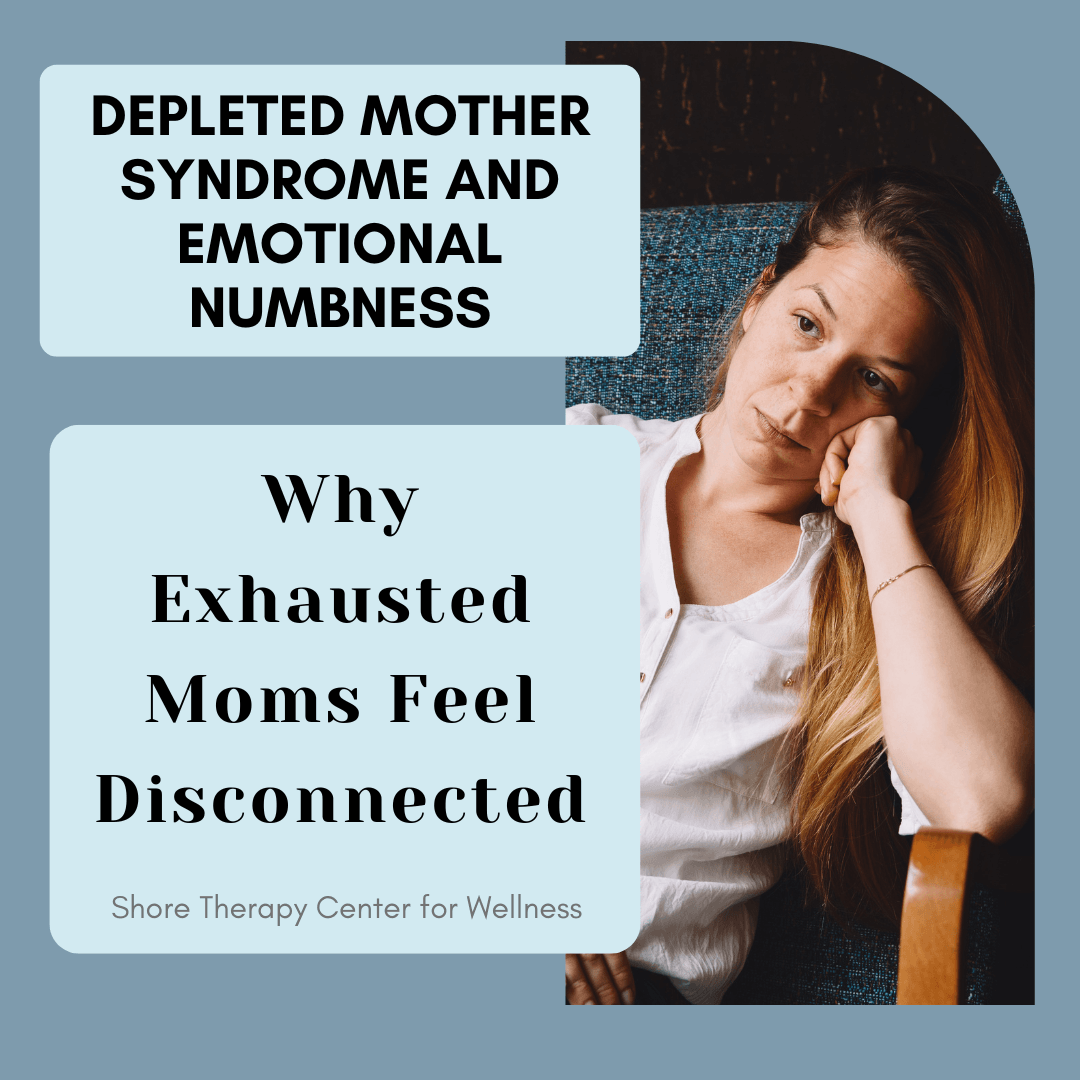
When Mom Burnout Starts to Feel Like Emotional Disconnection
You can love your kids deeply and want them to be supported, and still reach a point where you don't really want anyone to need anything from you.
Maybe your child is telling you about something that happened in their day and you are listening, but you can also hear yourself just giving the responses that let them know you're listening. You care about what they're saying. You care very much about them. But the interest or connection you expect to feel isn't quite there.
Or you finally get the break you've been wanting all day. No one is asking you a question, touching you, arguing, crying, or calling your name from another room. You have an hour when you could do almost anything you want, and instead you scroll through your phone because you can't think of anything you actually want to do.
For some mothers, this kind of emotional disconnection develops alongside the exhaustion, irritability, resentment, and reduced capacity associated with Depleted Mother Syndrome and parental burnout. It can also be one of the more unsettling changes, because it is easy to interpret feeling less connected as evidence that you are less connected.
You may wonder why you aren't happier to see your child after you've been apart, or feel yourself bracing when your older child calls because some part of you is already wondering what they might need. You may notice that affection sometimes feels like another demand, or that you are participating in moments you know matter to you without really feeling present for them. You may worry about what it means that you fantasize about being alone more often than you look forward to spending time together.
Emotional numbness can have many causes, and not every mother who feels disconnected is experiencing parental burnout. But for some exhausted mothers, it helps to look not only at what has become difficult to feel, but at the emotional experiences they have repeatedly had to move through while continuing to function.
That can give us a different way to understand why the numbness developed in the first place.
Is Emotional Numbness a Sign of Depleted Mother Syndrome?
Emotional numbness, reduced enjoyment, and feeling increasingly detached from your children can occur with parental burnout. Research on parental burnout includes emotional distancing from one's children as one of its central dimensions. “Depleted mother syndrome” is not a formal diagnosis, but the term is often used to describe a broader experience of physical and emotional depletion when the demands of motherhood repeatedly exceed the resources available to respond to them.
Numbness by itself does not establish that someone is experiencing burnout. Depression, trauma-related responses, grief, prolonged stress, physical health concerns, medications, and other factors can also affect emotional experience.
But when emotional disconnection develops alongside significant parenting exhaustion and other signs of parent burnout, it is worth considering the relationship between them.
And to understand that relationship, I think we have to look beyond how much a mother is doing.
Mom Burnout Also Has an Emotional Load
The practical and mental load of motherhood matters. But many parenting demands also have an emotional experience attached to them.
A baby has been waking every few hours for months, and you are trying to respond patiently while wondering how you will function tomorrow. Your child comes home devastated by something another child said, and you are trying to help them with their feelings while having your own. Your teenager is struggling, and you don't know whether they need encouragement, fewer demands, more support, or simply more time. Your adult child calls in distress, and after you hang up you carry your concern with you throughout your day.
For some mothers, the emotional demands become more persistent because a child needs substantial ongoing support. Parents of autistic, ADHD, gifted, and otherwise neurodivergent children may spend long periods trying to understand changing capacity, advocate for needs other people do not readily see, support regulation, and make decisions when there is no obviously right amount of support or expectation.
The circumstances vary, but the emotional problem can be similar: something that matters deeply is happening, you have a real emotional response to it, and you still need to figure out what to do next.
Sometimes there isn't much you can do.
You can see another family's vacation photo and feel something painful about how easy their experience looks. Maybe what hurts isn't wanting their vacation. Maybe it is recognizing how much planning, regulation, negotiation, recovery, or uncertainty can become part of the mental and emotional load of motherhood, even around experiences you want to enjoy with your own family.
You feel that for a moment.
Then somebody asks what's for dinner.
There is rarely a designated place in family life for the parent to stop and understand what just happened emotionally. The feeling may be real and important, but another part of life needs attention. So you respond to what is in front of you.
When emotionally significant experiences keep happening and there is rarely enough time, support, or capacity to notice what you are feeling, make sense of it, and allow the intensity to shift before something else requires you, continuing to experience all of it at full intensity can become difficult to sustain.
Understanding that emotional accumulation gives us useful context for what can happen next.
Why Can Mom Burnout Lead to Emotional Numbness?
Our autonomic nervous systems help us adjust to changing demands. When something requires attention or action, increased activation can help us focus, mobilize, solve problems, protect, advocate, and respond.
That capacity is useful in parenting. If your child is in danger, you want your system to help organize you around what matters. If someone has treated your child unfairly or unkindly, anger may give you energy to advocate. If your teenager's functioning changes dramatically, concern can direct your attention toward understanding what is happening and finding appropriate support.
The difficulty is that many of the concerns involved in parental burnout do not have a clean endpoint.
A friendship problem may resolve while your larger concern about your child's loneliness remains. Your teenager may get through a difficult period while you continue wondering what the next transition will bring. You may resolve one school problem without resolving your concern about whether the environment fits your child. Your young adult may make progress and then lose access to skills again during a period of increased stress or burnout. You may get through one difficult night knowing there will probably be another.
The system keeps being asked to mobilize around problems that matter deeply but cannot necessarily be solved today.
Over time, reducing emotional intensity can have a protective function.
Through a polyvagal framework, states of reduced activation, withdrawal, or shutdown are sometimes understood in relation to dorsal-vagal regulation when continued mobilization has become difficult to sustain. That framework can be useful for understanding some experiences of polyvagal theory and parent burnout, although emotional numbness is complex and should not be reduced to a single autonomic state.

The more important point is what the shift can accomplish.
If every difficult conversation, school email, disappointment, late-night call, unanswered text, setback, or change in functioning connects you with the full intensity of your fear about your child's future, it becomes difficult to respond only to the situation in front of you. If every night of disrupted sleep or long stretch of helping a child through something difficult connects you completely with your exhaustion, frustration, concern for your child, and fear about tomorrow, getting through it becomes harder. If every setback brings the full weight of every previous setback with it, there may be very little emotional space left for what needs to happen next.
Feeling less can make functioning easier.
That doesn't mean the numbness is deliberate. It doesn't mean a mother consciously decides not to feel something, or that every experience of emotional numbness develops for this reason. It means that emotional dampening can make sense as a regulatory adaptation when emotional activation has repeatedly exceeded what a person has room to experience while continuing to meet the demands in front of her.
Understanding that function matters, because mothers often interpret the resulting disconnection very differently.
Why Do Burned-Out Moms Feel Disconnected From Their Children?
The feelings you most want relief from are probably not love, affection, pleasure, or connection.
You may want some relief from worrying about whether your child is okay, whether you handled something well, whether you are giving one child enough attention while another needs more of you, or whether something that hurts right now will eventually get easier. You may want not to spend another evening worrying about whether your teenager will be able to return to school. You may want a break from wondering whether you are making the right decisions for a young adult who is struggling to function. You may want the helplessness of watching your child hurt to be less intense, or the guilt after losing your patience to stop following you through the whole rest of the day.
The problem is that emotional dampening is not necessarily precise enough to reduce only the feelings that are painful.
The same person who feels less frightened may also find it harder to become excited. The mother who has become somewhat detached from helplessness may also feel less emotionally present when her child wants to tell her something. Reducing emotional engagement enough to get through another demanding day may make it harder to re-engage simply because the immediate crisis has passed.
This can show up in surprisingly ordinary ways.
Maybe you used to enjoy talking with your child in the car and now find yourself hoping they will just put on their headphones. Your toddler brings you the same book for the fourth time and instead of enjoying their delight in it, you feel yourself wishing they would choose anything that doesn't require your participation. Your teenager wants to show you a video and you are aware that you are trying to look interested rather than actually feeling interested. Your adult child calls, and before answering you feel yourself anticipating what they may need from you.
Affection can change too. A child leaning against you on the couch may register less as closeness and more as additional sensory input. With an older child, the demand may be less physical: they want to talk at 11:30 p.m., need help thinking through a decision, or finally want connection at the exact moment when you have nothing left available for conversation. Your partner reaches for you at the end of the day and you realize that even wanted intimacy feels like another place where something is being asked of you.
And then there is the experience many exhausted mothers find particularly confusing: finally being alone and discovering that the relief they expected doesn't arrive.
No one needs you for the next hour, but you cannot think of anything you want to do. The book you wanted to read requires too much concentration. Calling a friend feels like work. You scroll through your phone because it asks very little of you, and when the hour is over you don't feel particularly restored.
This is one reason I think it is important to separate how much someone matters to you from how much emotional capacity you have available to experience that connection in a particular moment.
A mother can remain deeply committed to her child's well-being while having very little access to curiosity at the end of a depleted day. She can love being her child's mother while no longer enjoying much of the daily experience of parenting. She can value closeness while finding touch difficult to tolerate. She can want a relationship with her teenager or adult child while also experiencing their call or request as one more demand on a system with very little capacity left.
Those distinctions do not make emotional disconnection unimportant.
They change what the disconnection may mean.
For mothers parenting autistic, AuDHD, ADHD, PDA, anxious, 2e, and otherwise neurodivergent children, this distinction can become especially important when the level of support your child needs has changed over time, or grows and expands in uneven or inconsistent ways; when burnout has temporarily reduced access to skills or functioning they previously had, or when their support needs differ substantially from what other people assume a child of that age “should” need.
Emotional depletion can develop not because you have stopped wanting to be available to your child, but because being available has required sustained emotional and practical resources that have not been adequately replenished.
For parents raising neurodivergent children who recognize this broader pattern of depletion, my Parent Burnout Course for parents of neurodivergent kids offers a structured way to look more closely at capacity, demands, nervous-system regulation, expectations, and the changes that may make family life more sustainable.
Emotional Numbness Doesn't Always Mean Parent Burnout
Emotional numbness can occur with parental burnout, but burnout is not the only reason someone may feel emotionally flat or disconnected.

Depression can affect pleasure, motivation, energy, and emotional responsiveness. Trauma-related experiences can involve emotional numbing or detachment. Grief, prolonged stress, significant sleep disruption, medication effects, substance use, hormonal changes, and other physical or mental health conditions may also affect how emotionally present or connected someone feels.
Context therefore matters.
It may be useful to consider when the numbness began, whether it occurs primarily around parenting or across most areas of your life, what other emotional or physical changes you have noticed, and whether your ability to function or maintain relationships has changed.
Persistent, worsening, or distressing emotional numbness is worth discussing with a qualified healthcare or mental health professional. More immediate support is important if the disconnection is accompanied by thoughts of harming yourself or someone else, significant hopelessness, or concerns about your ability to safely care for yourself or your children.
Understanding that numbness can sometimes serve a protective function isn't meant to explain away something that deserves attention. It gives us another possibility to consider when trying to understand why the change has happened.
If you are trying to determine whether emotional disconnection is part of a broader pattern of parental burnout, the Parental Burnout Quiz can help you look at changes in exhaustion, emotional capacity, connection, and other aspects of your parenting experience together rather than trying to interpret numbness on its own.
Frequently Asked Questions About Mom Burnout and Emotional Numbness
Can parental burnout cause emotional numbness?
Parental burnout can involve emotional distancing from children, reduced enjoyment of parenting, and a sense of functioning without feeling fully emotionally engaged. Some parents experience this as numbness or describe themselves as “going through the motions.” Emotional numbness can also have other psychological or medical causes, so burnout should not automatically be assumed to be the explanation.
Is emotional numbness a sign of depleted mother syndrome?
Emotional numbness can occur alongside the exhaustion, irritability, reduced capacity, and emotional distancing mothers may describe as depleted mother syndrome. Depleted mother syndrome is not a formal diagnosis, however, and emotional numbness alone does not establish parental burnout. Looking at the broader pattern of symptoms and the circumstances in which the numbness developed is more useful.
Why do I feel emotionally disconnected from my children even though I love them?
Love and emotional capacity are related, but they are not identical. During significant burnout or prolonged stress, a parent may remain deeply committed to a child while having less access to feelings of warmth, pleasure, curiosity, patience, or connection. For some parents, broader emotional dampening may also reduce the intensity of painful emotions enough to help them continue functioning.
Why don't I enjoy being a mom anymore?
Reduced enjoyment of parenting can occur when exhaustion, parental burnout, chronic stress, depression, sleep disruption, or other difficulties affect emotional and physical capacity. Not enjoying parenting the way you once did does not by itself tell you how much you love your children. It can be more useful to look at what has changed in your experience and what may be contributing to that change.
Why do I feel irritated with my kids and then completely numb?
Irritability and emotional numbness can sometimes reflect different responses to sustained stress. At some points, increased activation may show up as frustration, urgency, anxiety, or anger; at others, reduced activation may feel more like withdrawal, flatness, or disconnection. The pattern can have several causes, so persistent or significant changes are worth exploring rather than assuming they are simply part of parenting.
When should I seek help for emotional numbness?
Consider professional support when emotional numbness is persistent, worsening, distressing, affecting important relationships, or interfering with daily functioning. Because numbness can occur with burnout as well as depression, trauma-related conditions, physical health concerns, medication effects, and other factors, individualized assessment can help clarify what may be contributing to it. Seek more immediate support if you are concerned about your safety or your ability to safely care for yourself or others.
Understanding the Numbness Gives Us a Different Place to Begin
When mothers become emotionally disconnected during burnout, the first interpretation is often about what the numbness says about them.
Maybe I have become too impatient. Maybe I don't enjoy my kids enough. Maybe I am selfish for wanting so much time away from them. Maybe a good mother would still feel differently.
I think it can be more useful to become curious about what was happening before the emotional distance became so noticeable.
What feelings have you repeatedly needed to set aside in order to respond to what was happening? What has required you to stay functional when part of you was frightened, angry, uncertain, helpless, or simply exhausted? Where has there been very little opportunity for your own emotional experience to have time or attention because something else needed to happen first?
Those questions don't tell us that burnout is definitely the reason you feel numb, and they don't tell us how to recover from it. They do give us a more accurate place from which to understand the experience.
If numbness has partly functioned to reduce emotional intensity, the goal is not simply to force yourself to feel more. Over time, having enough space and support to notice what you are feeling without immediately having to push it aside, or becoming overwhelmed by it, can make those feelings more accessible and more useful.
That next part matters enough that I don't want to compress it into a few paragraphs here. Difficult feelings such as grief, resentment, anger, fear, and envy can tell us something about what matters, what isn't working, what may need to be accepted, and what may need to change. Understanding how to use that information is different from understanding why you became numb in the first place.
For now, the important distinction is this:
Feeling disconnected from your children does not necessarily mean that your commitment or love for them has disappeared. Sometimes what has changed is your access to the emotional capacity that allows you to feel that connection as readily as you once did.
And if you recognize that your feelings have repeatedly needed to be set aside simply so that you could continue responding to what was happening, the next question isn't necessarily how to get rid of those feelings. It may be how to create enough room to notice what they are telling you about your needs, your limits, your values, your family, and the parts of your life that may need greater acceptance or meaningful change.
Emotional numbness is worth paying attention to for all moms, particularly when it has begun affecting your relationships, your enjoyment of your life, or your sense of yourself. But feeling disconnected does not necessarily tell you what you may initially fear it does. If some of the emotional distance developed in the context of repeatedly needing to contain fear, frustration, helplessness, uncertainty, or exhaustion well enough to keep functioning, then the numbness may be telling us something about your emotional capacity rather than the depth of your commitment to the people you love. Understanding that distinction does not resolve the burnout, but it changes where we begin: not with the assumption that you should simply try harder to feel connected, but with greater curiosity about what has made connection so difficult to access and what might need to become different for more of it to become available again.
